
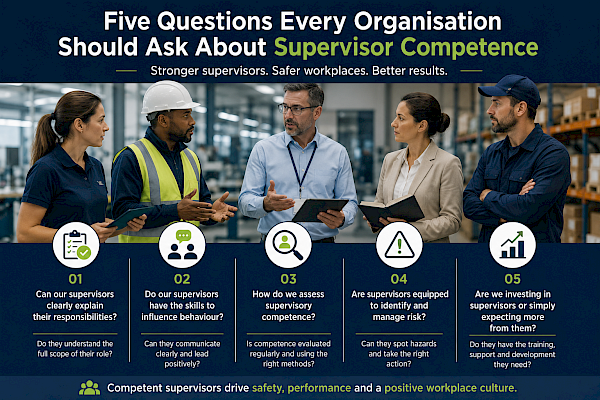
Five Questions Every Organisation Should Ask About Supervisor Competence
Most organisations understand that supervisors influence workplace culture, safety performance, productivity, quality and employee engagement.
However, many businesses make a critical mistake. They assume that because someone is experienced, technically capable or has been promoted into a supervisory role, they are automatically competent to supervise others.
The reality is that technical competence and supervisory competence are not the same thing.
A highly skilled operative, engineer, technician or administrator may possess exceptional technical knowledge, but still lack the leadership, communication and decision-making skills required to effectively supervise a team.
This raises an important question?
How can organisations be confident that their supervisors are genuinely competent?
The answer starts by asking the right questions.
1. Can our supervisors clearly explain their responsibilities?
One of the simplest ways to assess competence is to ask supervisors to describe their role.
Many organisations are surprised to discover that supervisors often focus exclusively on operational tasks whilst overlooking their responsibilities for safety, communication, workforce development and performance management.
A competent supervisor should understand that their responsibilities extend beyond allocating work and monitoring productivity.
They should be able to explain their role in:
- Leading by example
- Monitoring workplace standards
- Managing risks and hazards
- Supporting employee wellbeing
- Communicating organisational expectations
- Investigating incidents and concerns
- Developing workforce competence
- Driving continual improvement
If supervisors cannot clearly explain their responsibilities, it may indicate gaps in training, communication or organisational expectations.
2. Do our supervisors have the skills to influence behaviour?
Supervisors rarely succeed through authority alone.
The most effective supervisors understand how to influence behaviours through communication, engagement and leadership.
They know how to:
- Deliver clear instructions
- Challenge unsafe behaviours appropriately
- Manage difficult conversations
- Provide constructive feedback
- Encourage workforce involvement
- Build trust and credibility
Poor communication is frequently identified as a contributing factor in workplace incidents, operational failures and employee dissatisfaction.
Organisations should therefore consider whether supervisors have received formal development in leadership and communication skills rather than relying solely on technical expertise.
3. How do we assess supervisory competence?
Many businesses assess competence during recruitment but rarely revisit it afterwards.
Competence should not be viewed as a one-time achievement. It requires ongoing evaluation and development.
Effective organisations establish clear arrangements for assessing supervisors through:
- Performance reviews
- Workplace observations
- Audits and inspections
- Employee feedback
- Incident investigations
- Training records
- Competence assessments
The question should not be whether a supervisor attended a training course five years ago.
The question should be whether they continue to demonstrate competence today.
4. Are Supervisors Equipped to Identify and Manage Risk?
One of the most important responsibilities of any supervisor is recognising risk before it results in harm.
Workplaces are constantly changing. New personnel, equipment, contractors, processes and environments can all introduce new hazards.
Competent supervisors should be capable of:
- Identifying workplace hazards
- Understanding risk controls
- Reviewing risk assessments
- Monitoring safe systems of work
- Responding to changing conditions
- Escalating concerns when necessary
If supervisors are unable to recognise emerging risks, organisations lose one of their most effective safeguards against incidents.
This is why risk management skills should form a core component of supervisory development programmes.
5. Are we investing in supervisors or simply expecting more from them?
Many organisations promote employees into supervisory positions because they are technically competent and highly respected.
Unfortunately, promotion often comes with increased responsibility but limited support.
Supervisors are expected to manage people, resolve conflict, monitor performance, maintain standards, support wellbeing, oversee safety and deliver operational objectives, often without receiving formal training in these areas.
A lack of investment can leave supervisors feeling unsupported and underprepared.
Forward-thinking organisations recognise that supervisory competence must be developed through:
- Structured supervisory training such as:
- IOSH Supervising Safely or
- Site Supervision Safety Training (SSSTS)
- Industry specific vocational qualifications (Levels 3 or 4)
- Mentoring programmes
- Leadership development
- Coaching and support
- Continuing professional development
- Regular feedback and review
Investing in supervisors is not simply a training exercise. It is an investment in organisational performance.
Why supervisor competence matters more than ever
Today's supervisors operate in increasingly complex environments.
They must balance productivity, quality, customer expectations, workforce wellbeing, legal compliance and health and safety responsibilities simultaneously.
The organisations that perform best understand that supervisors are not simply task managers.
They are leaders, communicators, coaches and decision-makers who have a direct influence on workplace culture and operational success.
When supervisors are competent, employees are more engaged, risks are better controlled, incidents are reduced and performance improves.
When supervisors lack competence, even the strongest management systems can struggle to achieve their intended outcomes.
In Summary
Supervisor competence should never be assumed.
It should be defined, assessed, developed and continuously reviewed.
By asking these five questions, organisations can gain valuable insight into the effectiveness of their supervisory teams and identify opportunities to strengthen leadership across the business.
After all, policies and procedures may establish expectations, but it is competent supervisors who turn those expectations into everyday behaviours.
And that is where real organisational performance begins.