
HSE's Position on Dry Cutting Engineered Stone: What the Construction Industry Needs to Know
HSE's Position on Dry Cutting Engineered Stone: What the Construction Industry Needs to Know
For years, respirable crystalline silica (RCS) has been described as one of the construction industry's biggest hidden killers.
Now, following growing concerns surrounding engineered stone (quartz worktops), the Health and Safety Executive (HSE) has made its expectations even clearer: Dry cutting engineered stone should no longer be taking place because the risks cannot be adequately controlled.
While much of the attention has focused on the kitchen worktop industry, the message is much broader than quartz alone.
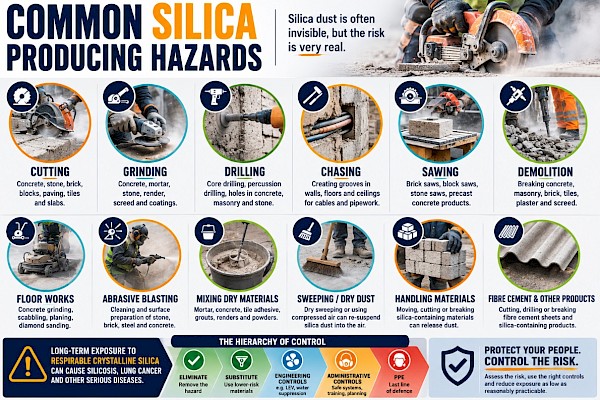
Any construction activity involving dry cutting, grinding, chasing or polishing silica-containing materials can expose workers to dangerous levels of respirable crystalline silica.
It is becoming an issue of legal compliance, competent risk management and protecting workers from entirely preventable occupational disease.
What is Respirable Crystalline Silica?
Respirable crystalline silica (RCS) is an extremely fine dust produced when materials containing crystalline silica are cut, drilled, ground or polished.
The particles are so small that they bypass the body's natural defences and become lodged deep inside the lungs.
Common construction materials containing silica include:
Engineered stone (quartz worktops)
- Concrete
- Brick
- Mortar
- Sandstone
- Granite
- Artificial stone
- Fibre cement products
- Paving slabs
- Roof tiles
- Clay bricks
- Ceramic products
Many people wrongly assume that only engineered stone presents a risk. In reality, silica dust has been recognised as a major occupational health hazard across construction for decades.
Why is Engineered Stone Different?
Engineered stone can contain more than 90% crystalline silica, significantly more than many natural stones.
This means cutting or grinding quartz can generate enormous concentrations of respirable silica in a very short period of time.
Across the world, there has been a significant rise in cases of accelerated silicosis among relatively young workers fabricating engineered stone worktops.
Unlike traditional silicosis, accelerated silicosis can develop after only a few years of high exposure.
Some workers have required lung transplants, others have died.
HSE's Position Has Become Increasingly Clear
The HSE has made its expectations clear: dry processing of engineered stone should not be undertaken because the resulting exposure to respirable crystalline silica cannot be adequately controlled.
Current guidance strongly promotes:
- Wet cutting methods
- Local Exhaust Ventilation (LEV)
- Suitable respiratory protective equipment (RPE)
- Exposure monitoring
- Health surveillance
- Proper training
- Competent supervision
Where dry cutting is undertaken without effective engineering controls, employers are unlikely to be meeting their duties under the Control of Substances Hazardous to Health Regulations (COSHH).
Simply issuing disposable dust masks is not an adequate control measure. Control of exposure must follow the hierarchy of control.
This Isn't Just About Engineered Stone
One of the biggest misunderstandings is that if you don't install kitchen worktops, the issue doesn't apply to your business.
Unfortunately, that's not the case.
Silica dust is generated every day during:
- Disc cutting concrete
- Chasing walls
- Cutting blocks
- Brick saws
- Angle grinding mortar
- Core drilling
- Demery and demolition works
- Sanding concrete floors
- Masonry restoration
Many of these tasks are still carried out dry on construction sites.
In some cases, workers continue using petrol cut-off saws with no dust suppression at all.
These practices expose not only the operator but everyone working nearby.
What Should Contractors Do Now?
Construction companies should review their silica management arrangements immediately.
Questions worth asking include:
- Are any tasks still carried out dry?
- Can wet cutting replace them?
- Is LEV properly tested and maintained?
- Are RPE face-fit tests up to date?
- Has exposure monitoring ever been undertaken?
- Are workers receiving health surveillance?
- Are supervisors challenging poor practices?
- Are RAMS genuinely reflecting site activities?
If the answer to any of these questions is "no", there is likely to be room for significant improvement.
A Wider Cultural Change
The construction industry continues to make progress in reducing immediate accidents.
Occupational health now deserves the same attention.
Workers cannot see silica dust.
They may not become ill for many years.
However every unnecessary exposure adds to a lifetime dose that cannot be taken back.
The move away from dry cutting engineered stone is part of a wider shift towards preventing occupational disease before it occurs.
Ultimately, protecting workers from silica exposure is not simply about complying with regulations.
It is about ensuring that people who build our homes, schools and workplaces can enjoy healthy lungs long after they leave the construction industry.
Need Advice on Managing Silica Risks?
If your organisation undertakes cutting, drilling, grinding or demolition work, a review of your COSHH assessments, safe systems of work and exposure controls can help ensure compliance with current HSE expectations while protecting your workforce.
Our health and safety advisors can assist with:
- Silica risk assessments and COSHH reviews.
- Site inspections and compliance audits.
- Dust control strategies and hierarchy of control reviews.
- LEV and RPE management.
- Health surveillance planning.
- Supervisor and workforce awareness training.
The recent focus on engineered stone should not be viewed as an isolated issue. It reflects HSE's broader strategy to reduce occupational ill health by ensuring employers fully comply with their existing duties under COSHH. For construction businesses, now is the time to review work methods, eliminate unnecessary dust generation, and adopt engineering controls that protect workers from one of the industry's most significant long-term health risks
Key Legislation and HSE Guidance
The management of respirable crystalline silica (RCS) is underpinned by a combination of legislation, Approved Codes of Practice (ACoPs) and HSE guidance. Employers should ensure they are familiar with the following key documents.
1. Control of Substances Hazardous to Health Regulations 2002 (COSHH)
COSHH places a legal duty on employers to prevent exposure to hazardous substances wherever reasonably practicable. Where prevention is not possible, exposure must be adequately controlled through the application of the hierarchy of control.
Key employer duties include:
- Undertaking suitable and sufficient COSHH assessments.
- Preventing or adequately controlling exposure.
- Maintaining engineering controls, including Local Exhaust Ventilation (LEV).
- Providing suitable Respiratory Protective Equipment (RPE) where required.
- Monitoring exposure where appropriate.
- Providing health surveillance where employees are exposed to risks such as respirable crystalline silica.
- Ensuring employees receive suitable information, instruction and training.
For silica dust, COSHH requires employers to reduce exposure as low as is reasonably practicable, not merely below the Workplace Exposure Limit.
2. EH40/2005 Workplace Exposure Limits
EH40 sets the legal Workplace Exposure Limits (WELs) for hazardous substances in Great Britain.
For Respirable Crystalline Silica (RCS) the current Workplace Exposure Limit is:
- 0.1mg/m³ (8-hour Time Weighted Average)**
However, HSE makes clear that compliance with the WEL alone is not sufficient where further exposure reduction is reasonably practicable. Employers are expected to minimise exposure through effective engineering controls and safe systems of work.
3. HSE Guidance – Silica
HSE recognises respirable crystalline silica as one of the most significant long-term health risks within construction.
Its guidance focuses on:
- Identifying silica-generating activities.
- Eliminating or reducing dust generation.
- Using water suppression.
- Using Local Exhaust Ventilation (LEV).
- Correct selection and face-fit testing of Respiratory Protective Equipment (RPE).
- Health surveillance.
- Worker competence and supervision.
- Monitoring exposure where appropriate.
HSE's Control of Substances Hazardous to Health (COSHH) Essentials task sheets also provide practical guidance for many common construction activities involving silica dust.
4. HSE Guidance – Engineered Stone
Following increasing cases of accelerated silicosis associated with engineered stone fabrication, HSE has strengthened its published guidance.
Its current position is that:
- Dry processing of engineered stone should not be undertaken.
- Wet processing methods should be used wherever possible.
- Suitable engineering controls must be implemented.
- LEV should be used where appropriate.
- Suitable RPE remains the last line of defence and should never replace engineering controls.
- Employers should review their COSHH assessments to ensure risks are adequately controlled.
This guidance reflects HSE's expectation that employers cannot adequately control respirable crystalline silica generated through uncontrolled dry processing of engineered stone.
5. Construction (Design and Management) Regulations 2015 (CDM)
Although CDM is not specific to silica dust, it requires duty holders to eliminate, reduce and manage health risks throughout the planning and delivery of construction work.
Designers, principal contractors and contractors all have responsibilities to consider occupational health risks alongside traditional safety hazards.
6. HSE Inspectors Will Expect to See
During inspections involving silica-generating activities, HSE inspectors are likely to examine whether employers can demonstrate:
- Suitable and sufficient COSHH assessments.
- Appropriate selection of work methods.
- Elimination of unnecessary dry cutting.
- Effective water suppression.
- Properly maintained LEV systems.
- Face-fit tested RPE.
- Health surveillance records.
- Evidence of employee training.
- Supervision of dust-generating activities.
- Maintenance and examination records for engineering controls.
Simply issuing dust masks without demonstrating the wider hierarchy of control is unlikely to satisfy regulatory expectations.
Useful HSE Publications
For employers wishing to review the latest guidance, the following HSE publications should form part of their occupational health management arrangements:
- Control of Substances Hazardous to Health Regulations 2002 (as amended).
- EH40/2005 Workplace Exposure Limits (latest edition).
- HSG53 Respiratory Protective Equipment at Work.
- HSG258 Controlling Airborne Contaminants at Work: A Guide to Local Exhaust Ventilation (LEV).
- COSHH Essentials guidance sheets relating to silica-generating construction activities.
- HSE Guidance on Engineered Stone and Respirable Crystalline Silica.
- HSE Construction Dust Guidance.
FREQUENTLY ASKED QUESTIONS
1. Is dry cutting engineered stone illegal?
There is currently no specific law that expressly prohibits the dry processing of engineered stone. However, the Health and Safety Executive (HSE) has made its position clear that dry processing of engineered stone should not be undertaken, as exposure to respirable crystalline silica (RCS) cannot be adequately controlled using this method. Employers who continue to use dry cutting may find it difficult to demonstrate compliance with their legal duties under the Control of Substances Hazardous to Health Regulations 2002 (COSHH).
2. Does wearing an FFP3 mask make dry cutting safe?
No. Respiratory Protective Equipment (RPE), including FFP3 disposable masks, should never be relied upon as the primary control measure. Under COSHH, employers must follow the hierarchy of control by eliminating or reducing dust generation wherever reasonably practicable. This means using wet cutting methods, Local Exhaust Ventilation (LEV) and other engineering controls before relying on RPE as the final line of defence.
3. Which construction materials produce respirable crystalline silica (RCS)?
Respirable crystalline silica is generated whenever many common construction materials are cut, drilled, ground or demolished. These include:
- Engineered stone (quartz worktops)
- Concrete
- Brick and blockwork
- Mortar and screed
- Sandstone and granite
- Paving slabs
- Fibre cement products
- Roof tiles
- Ceramic products
Although engineered stone contains particularly high levels of crystalline silica, many everyday construction tasks can generate hazardous dust if appropriate controls are not in place.
4. When is health surveillance required for silica dust exposure?
Health surveillance should be considered where workers are regularly exposed to respirable crystalline silica and there remains a foreseeable risk to their health despite the implementation of control measures. Employers should assess exposure through their COSHH risk assessment and, where appropriate, introduce suitable health surveillance alongside exposure monitoring, training and regular review of dust control measures.
5. How should I structure an effective and compliant health surveillance programme for my stone masons and stone worktop fabricators?
COSHH requires employers to provide appropriate health surveillance where there is a reasonable likelihood that exposure could cause occupational disease and where valid techniques exist to detect early signs of ill health. The Regulations do not prescribe specific surveillance intervals.
To help employers meet these duties, HSE guidance recommends the following approach for workers regularly exposed to respirable crystalline silica:
Initial (baseline) health screening before, or as soon as practicable after, an employee starts work in a silica-exposed role. This should include a respiratory health questionnaire and baseline lung function testing (spirometry).
Annual health surveillance using a respiratory health questionnaire to identify any new or worsening respiratory symptoms.
Spirometry (non-invasive lung function test) every three years for employees who remain regularly exposed to respirable crystalline silica, allowing changes in lung function to be identified over time.
Annual spirometry after 15 years of continuous exposure to respirable crystalline silica, recognising the increased risk of occupational lung disease associated with long-term cumulative exposure.
If an employee reports respiratory symptoms, demonstrates a significant reduction in lung function, or exposure monitoring indicates that existing controls may not be effective, they should be referred for further occupational health assessment. Employers should also review their COSHH risk assessment and the effectiveness of exposure controls, including local exhaust ventilation (LEV), water suppression, respiratory protective equipment (RPE) and dust monitoring.