
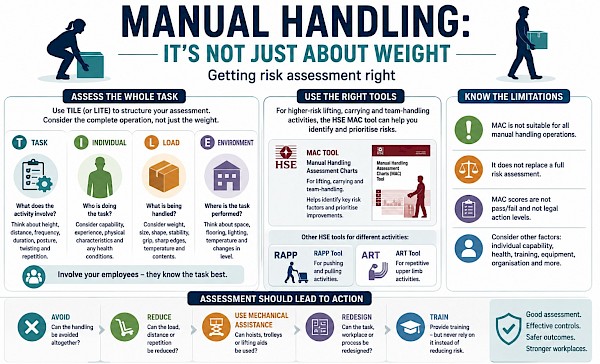
Manual Handling: It’s Not Just About Weight
Manual handling is one of those workplace risks that can easily become oversimplified.
Ask someone whether a lift is safe and the first question is often:
- "How heavy is it?"
Weight matters, but it is only one part of the assessment.
The Manual Handling Operations Regulations 1992 require employers to avoid hazardous manual handling operations so far as reasonably practicable. Where they cannot be avoided, the risk of injury must be assessed and reduced so far as reasonably practicable.
Importantly, there is no single legal maximum lifting weight.
Whether a manual handling activity presents a significant risk depends upon the complete operation:
- the task,
- the person carrying it out,
- the load being handled
- the environment in which the activity takes place.
A commonly used approach to structuring a manual handling risk assessment is TILE:
T – Task
- What does the activity involve? Consider lifting height, carrying distance, frequency, duration, twisting, reaching, stooping and whether repetitive movements are required.
I – Individual
- Who is carrying out the activity? Consider individual capability, experience, physical characteristics and whether anyone may be at increased risk.
L – Load
- Consider more than weight. Is the load large, bulky, unstable, difficult to grip, sharp, hot or likely to move unexpectedly?
E – Environment
- Consider the space available, floor condition, lighting, temperature, changes in level and anything else that could restrict safe movement.
You may also see this referred to as LITE.
Load
Individual
Task
Environment
The principle is essentially the same: looking at the handling operation as a whole rather than focusing on one factor in isolation.
TILE or LITE provides a useful structure for asking the right questions, but simply putting four headings on a risk assessment does not automatically make the assessment suitable and sufficient.
When should the HSE MAC tool be considered?
For higher-risk lifting, carrying and team-handling activities, HSE's Manual Handling Assessment Charts; the MAC tool can provide a more structured assessment.
The MAC uses numerical scoring and colour coding to help identify and prioritise significant risk factors.
Depending on the activity, it considers factors such as load weight and frequency, hand position, vertical lift zones, twisting, carrying distance, grip, floor conditions and other aspects of the operation.
This can make the MAC particularly useful where an assessor needs to understand which parts of a handling activity are contributing most significantly to the risk.
The scoring can also help prioritise improvements and compare the effect of proposed changes.
A MAC score should not simply be attached to a risk assessment and regarded as proof that the assessment is complete.
HSE specifically states that the MAC is ‘not appropriate for all manual handling operations and may not constitute a fully suitable and sufficient risk assessment if relied upon alone’.
There are several important limitations.
The standard MAC is intended for lifting, carrying and team-handling operations. It is not the appropriate HSE tool for pushing and pulling activities, where the RAPP tool (Risk Assessment of Pushing and Pulling) should be considered instead.
It was also not designed for people-handling assessments, and repetitive upper-limb activities. These activities may require consideration using HSE's ART tool (Assessment of Repetitive Tasks.)
The MAC also does not capture every factor required by the Manual Handling Operations Regulations. Individual capability, specific health considerations, psychosocial factors and other characteristics of the activity may require separate consideration.
Most importantly, MAC scores are not pass or fail scores and they are not legal action levels. Their purpose is to help identify and prioritise areas requiring attention.
Assessment should lead to action
Whatever assessment method is used, the purpose is not simply to produce another document.
If the assessment identifies significant manual handling risk, the next question should be:
- Can we avoid the handling activity altogether?
If not,
- can mechanical assistance be introduced?
- Can the load be reduced or divided? Can its location be changed?
- Can the workplace or task be redesigned?
- Can carrying distances, repetition or awkward postures be reduced?
Manual handling training may form part of the solution, but training employees to lift correctly should never be used as a substitute for addressing avoidable risks within the task itself.
A good manual handling assessment therefore moves beyond "How heavy is it?" and considers the complete handling operation.
TILE or LITE can provide the structure. HSE assessment tools can provide additional analysis where appropriate. But professional judgement, employee involvement and effective risk reduction remain essential.
Your Principal Adviser can support you in reviewing manual handling activities, selecting an appropriate assessment method and identifying practical controls where significant risks are identified.