
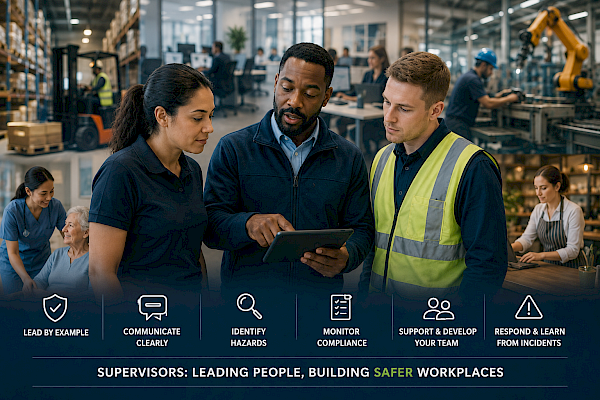
Why Supervisors are the Cornerstone to Workplace Safety
Successful health and safety management systems have one thing in common: effective supervision.
Whilst directors establish strategic direction, managers coordinate operational delivery, and health and safety professionals develop the systems, procedures and controls that support compliance, it is supervisors who bridge the gap between policy and practice. They are the individuals closest to day-to-day operations, responsible for translating organisational expectations into safe working behaviours. Through direct engagement with workers, supervisors ensure that safety standards are understood, implemented and maintained across construction sites, workshops, warehouses, offices and other operational environments.
Without effective supervision, even the most comprehensive health and safety management system can fail. This is why supervisors are often described as the cornerstone of workplace safety.
What is the role of a Supervisor in health and safety?
A supervisor's primary responsibility is to ensure work activities are carried out safely, efficiently and in accordance with company procedures.
Unlike senior managers who may be removed from day-to-day operations, supervisors maintain direct contact with workers and are uniquely positioned to identify hazards, correct unsafe behaviours and influence workplace culture.
Effective supervisors provide leadership through visible presence, communication and engagement with their teams.
Their responsibilities often include:
- Monitoring work activities and standards
- Conducting workplace inspections
- Ensuring safe systems of work are followed
- Delivering briefings and toolbox talks
- Identifying hazards and controlling risks
- Investigating incidents and near misses
- Supporting employee training and competence
- Encouraging positive safety behaviours
- Reporting concerns to management
Supervisors act as the first line of defence against workplace accidents and injuries.
Why Supervisors have such a significant impact on safety performance
Research consistently shows that workplace culture is heavily influenced by immediate front-line management.
Employees are more likely to follow safety procedures when supervisors demonstrate commitment to health and safety through their actions rather than simply their words.
When supervisors challenge unsafe behaviour, conduct regular inspections and lead by example, workers understand that safety is a genuine organisational priority.
Conversely, where supervisors overlook unsafe acts, fail to address poor standards or prioritise production over safety, employees quickly recognise that safety expectations are not being enforced.
This influence makes supervisors one of the most important contributors to organisational safety performance.
The key responsibilities of an effective safety supervisor
Leading by example
Safety leadership begins with personal conduct.
Supervisors must consistently demonstrate compliance with company rules, risk controls and safe working procedures. Employees are more likely to adopt positive behaviours when they see supervisors actively following the same standards expected of them.
A supervisor who wears the correct PPE, follows site rules and participates in safety discussions establishes credibility and trust.
Communicating safety expectations
Communication remains one of the most important supervisory skills.
Supervisors should ensure workers understand:
- Site-specific hazards
- Risk assessments and method statements
- Emergency procedures
- Safe systems of work
- Changes to working conditions
- Lessons learned from incidents
Regular toolbox talks, briefings and informal discussions help reinforce key safety messages and maintain awareness throughout the workforce.
Identifying hazards before they cause harm
One of the most valuable contributions a supervisor can make is proactive hazard identification.
Workplaces change constantly. New equipment, changing environments, different contractors and evolving work activities can all introduce new risks.
Effective supervisors continuously monitor their work areas and take action before hazards develop into incidents.
This proactive approach helps reduce accidents, delays, damage and financial losses.
Monitoring compliance
Health and safety procedures are only effective when consistently applied.
Supervisors should regularly observe work activities to ensure employees are following agreed control measures and safe systems of work.
Monitoring compliance is not about policing workers. It is about supporting employees, identifying barriers to safe working and ensuring controls remain effective.
Supporting workforce development
Competence is a fundamental component of workplace safety.
Supervisors play an important role in identifying training needs, mentoring less experienced workers and ensuring employees understand their responsibilities.
By supporting workforce development, supervisors contribute to both improved safety performance and operational efficiency.
Managing incidents and near misses
Despite best efforts, incidents can still occur.
When they do, supervisors are often among the first people involved in the response.
Their responsibilities may include:
- Securing the area
- Providing immediate support
- Reporting the incident
- Preserving evidence
- Participating in investigations
- Implementing corrective actions
- Communicating lessons learned
Effective incident management helps organisations prevent recurrence and strengthen overall safety performance.
Supervisors and safety culture
Safety culture is often described as "the way we do things around here."
Supervisors have a greater influence on this culture than almost any other role within an organisation.
They shape attitudes, reinforce expectations and establish standards through daily interactions with employees.
A positive safety culture develops when supervisors:
- Encourage open communication
- Promote reporting of concerns
- Recognise positive behaviours
- Address unsafe acts fairly and consistently
- Demonstrate visible commitment to safety
When supervisors create an environment where employees feel comfortable raising concerns, organisations gain valuable opportunities to prevent incidents before they occur.
Common challenges facing supervisors
Modern supervisors face increasing pressures.
They are often expected to balance productivity, quality, programme deadlines, customer expectations and health and safety responsibilities simultaneously.
Common challenges include:
- Time pressures
- Workforce shortages
- Changing work environments
- Contractor management
- Training requirements
- Behavioural safety issues
Successful supervisors understand that safety is not separate from operational performance. Safe work is efficient work, and strong safety management contributes directly to productivity, quality and business success.
Investing in supervisory development
Many organisations invest heavily in management systems, technology and compliance processes while overlooking supervisory development.
However, developing supervisors can deliver significant improvements in safety performance.
Training supervisors in leadership, communication, risk management, behavioural safety and incident investigation helps create stronger safety cultures and more resilient organisations.
The most successful businesses recognise that competent supervisors are not simply task managers; they are safety leaders.
In Summary
Workplace health and safety does not happen by accident.
Policies, procedures and risk assessments provide the framework, but supervisors bring those arrangements to life.
Through leadership, communication, hazard identification, workforce engagement and continual monitoring, supervisors influence safety performance every day.
For organisations seeking to improve workplace safety, reduce incidents and strengthen safety culture, investing in supervisory competence and leadership is one of the most effective steps they can take.
Strong supervisors create safer workplaces, stronger teams and better business outcomes.