
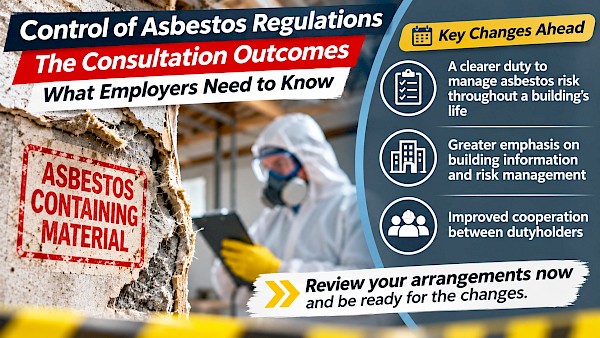
What Employers and Dutyholders Need to Know
The Health and Safety Executive (HSE) has published the findings of its consultation on proposed changes to the Control of Asbestos Regulations 2012 (CAR 2012), confirming amendments aimed at strengthening asbestos management arrangements and improving protection for workers and building occupants.
The consultation, which ran from 10 November 2025 to 9 January 2026, received 358 responses from industry stakeholders. Following consideration of the findings, the HSE has confirmed action across three key areas.
What Changes Have Been Confirmed?
1. Independent Four-Stage Clearance Assessments
The most significant legislative change concerns the independence of asbestos analysts undertaking four-stage clearance assessments following licensed asbestos removal work.
Regulation 20 is being amended to prevent asbestos removal contractors from appointing the analysts responsible for assessing and certifying their own work.
Instead, arrangements will need to be made for analysts to be appointed independently, normally by the client or building dutyholder. This is intended to reduce potential conflicts of interest and provide greater confidence that premises are safe for reoccupation.
2. Improving the Quality of Asbestos Surveys
The HSE has confirmed that it will strengthen guidance to help dutyholders understand the importance of commissioning suitable and reliable asbestos surveys.
Although mandatory accreditation for all asbestos surveying organisations has not been introduced, the HSE continues to strongly recommend using UKAS-accredited organisations.
Further guidance will support dutyholders in selecting competent surveyors and understanding their responsibilities when commissioning asbestos surveys.
3. Clarification of Notifiable Non-Licensed Work (NNLW)
The existing NNLW classification will remain in place.
However, consultation findings identified continuing confusion regarding which asbestos-related activities fall within this category.
The HSE intends to develop clearer guidance to help employers and contractors correctly classify asbestos work and understand the associated notification, training and health surveillance requirements.
When Will the Changes Take Effect?
The Control of Asbestos (Amendment etc.) Regulations 2026, made on 2 November 2026 and laid before Parliament on 3 November 2026, with general provisions coming into force around late November 2026.
Transition period: The requirement barring removal contractors from appointing clearance analysts takes effect on 25 November 2027, giving dutyholders and contractors a 12-month transition period to adjust procurement arrangements.
This provides a 12-month transition period for the industry to review existing arrangements and prepare for compliance.
The HSE has also confirmed plans to update its Approved Code of Practice (L143), Managing and working with asbestos, and associated guidance, including Asbestos: The Analysts' Guide.
Further improvements to asbestos surveying and NNLW guidance are being developed, although specific publication dates have not yet been confirmed.
What Does This Mean for Employers and Dutyholders?
For building owners, landlords, managing agents and organisations responsible for maintaining non-domestic premises, the changes reinforce the importance of effective asbestos management.
Where licensed asbestos removal work is commissioned, clients and dutyholders should review their arrangements for appointing independent asbestos analysts, ensuring appropriate accreditation and competence.
Employers and contractors should also review their procedures for identifying asbestos before work begins, accessing asbestos registers, selecting competent service providers and correctly classifying asbestos-related activities.
Importantly, the existing legal duty to manage asbestos under Regulation 4 remains unchanged. Dutyholders must continue to identify, assess and manage asbestos-containing materials, maintain appropriate records and communicate relevant information to anyone who may disturb them.
Preparing for the Changes
Although the principal legislative amendment does not take effect until November 2027, organisations should use the transition period to review their asbestos management procedures, contractor appointment arrangements and existing documentation.
The message is clear: effective asbestos management is not simply about identifying asbestos. It requires competent assessments, appropriate controls, independent verification where required and ongoing management of the risks.
Taking proactive steps now will help organisations prepare for the forthcoming changes whilst continuing to meet their existing legal responsibilities.