
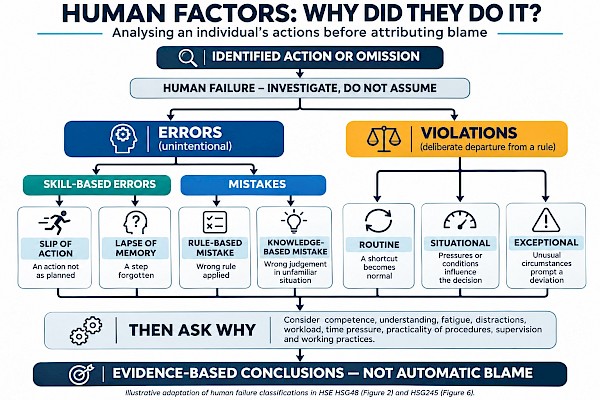
Identifying What Someone Did Wrong Is different from Understanding Why They Did It
Throughout 2026, our Principal Advisors at C&C Consulting have undertaken a several serious workplace accident and incident investigations.
One recurring observation has been the tendency for initial incident reports to identify an individual's actions or omissions as the cause of an incident, without fully exploring the reasons behind their behaviour.
Statements such as:
- "the employee failed to follow the procedure"
- "the operative did not undertake the required checks"
- "the individual failed to comply with their training"
Whilst these statements may accurately describe what happened, they do not necessarily explain why it happened.
In many of the investigations we have reviewed, there has been little evidence that the individual's behaviour was analysed before reaching these conclusions. This can leave the reader with the impression that the incident was simply the fault of the person involved.
Understanding Human Behaviour – The Missing Investigation Stage
The Health and Safety Executive's guidance, HSG245 – Investigating Accidents and Incidents, encourages investigators to look beyond the immediate circumstances and establish why an incident occurred.
Supporting this approach, HSG48 –Reducing Error and Influencing Behaviour provides a framework for understanding different types of human failure.
Human failures generally fall into two categories:
- unintentional errors
- Deliberate violations
Understanding the difference is an important part of determining why an individual acted, or failed to act, in a particular way.
Slips and Lapses – Unintentional Errors: An individual knows what they should do but makes an unintended error or forgets an important step. For example, an experienced operative unintentionally omits a safety check despite understanding the requirement.
Mistakes – Errors in Judgement: An individual makes a conscious decision believing it to be correct, but their understanding or judgement is mistaken. This may involve incorrectly applying an established procedure or making an unsuitable decision when confronted with unfamiliar circumstances.
Violations – Deliberate Departures: An individual knowingly departs from an established rule or procedure. However, even where the departure is intentional, investigators should seek to understand why. Was it a shortcut that had become routine? Was the individual responding to time pressures, or did they believe the procedure was unnecessary or impractical?
These distinctions matter because the same action or omission can arise from very different circumstances, each requiring a different investigation outcome and potentially different preventative measures.
For Example:
- An operative commences work without completing a required safety check.
- The initial investigation concludes that the operative failed to follow the established procedure.
But what does that tell us?
- Did the operative simply forget the check?
- Did they misunderstand when it was required?
- Did they believe somebody else had already completed it?
- Did they knowingly choose to proceed without it?
Each possibility presents a different explanation for the same observed failure.
Without examining the individual's understanding, intentions and the circumstances surrounding their decision, how can an investigator confidently determine whether the behaviour was an error, a mistake or a violation?
Understanding Why the Individual Acted That Way
Once the type of human failure has been considered, investigators can explore the factors that may have influenced the individual's behaviour.
These might include their knowledge and experience, familiarity with the task, understanding of the risks, level of attention, fatigue, perceived pressures or established working habits.
The purpose is not to find excuses for unsafe behaviour, but to establish the circumstances that contributed to it.
Importantly, even a deliberate violation should not automatically bring the investigation to an end.
The individual may have knowingly departed from a procedure but understanding why they made that decision remains essential to establishing the complete circumstances of the incident.
Equally, investigators must recognise that some actions may involve poor personal judgement or deliberate disregard for safety requirements. A balanced investigation must be capable of identifying these circumstances without reaching premature conclusions.
Accountability and Understanding Can Coexist
Investigating human behaviour does not mean removing individual responsibility or suggesting that every unsafe action must have an explanation beyond the individual's control.
Employees have responsibilities to follow safe systems of work and take reasonable care of themselves and others.
However, an effective investigation should distinguish between what an individual did, whether their action was intentional and what influenced their decision.
Identifying an individual's failure may establish an immediate contributing factor. Understanding the behaviour behind that failure provides the evidence needed to reach a more informed conclusion.
Incident investigations should be objective, evidence-based and focused on establishing the circumstances that led to an event.
Simply identifying that somebody did something wrong is not the same as establishing why they did it.
At C&C Consulting, we believe that understanding the human element is an essential part of effective incident investigation.
An investigation should not become a blame game. It should establish what happened, why the individual acted as they did and what can be learned to prevent a recurrence.