
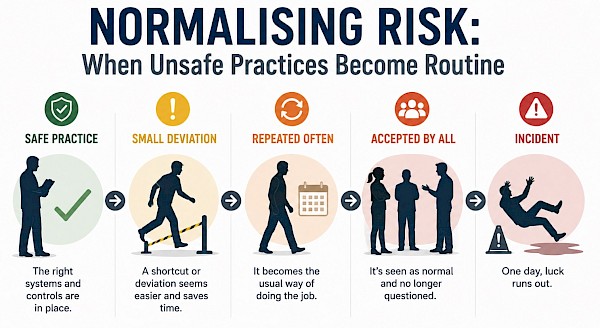
Normalising Risk: When Unsafe Practices Become Routine
Most serious workplace accidents do not begin with someone deliberately deciding to work unsafely.
More often, small deviations from the expected way of working gradually become accepted.
- A guard is removed because a task is easier without it.
- A pedestrian takes a shortcut through a vehicle route.
- Someone works from the top rung of a stepladder because "it will only take a minute".
- An isolation procedure is shortened because the machine needs to be back in production.
Nothing happens.

The behaviour is repeated.

Again, nothing happens.

Eventually the shortcut becomes the normal way of working.
This gradual acceptance of unsafe practices is sometimes described as normalisation of deviance; where departures from an established safe system become accepted simply because they have not yet resulted in an accident.
Success does not prove something is safe
One of the challenges for businesses is that unsafe behaviour can appear to be successful.
If someone has climbed onto unsuitable equipment fifty times without falling, the absence of an accident can unintentionally reinforce the belief that the method is safe.
But the risk has not disappeared.
The worker has simply experienced fifty occasions where the unwanted outcome did not occur.
This can be particularly significant where employees have carried out the same activity for many years. Familiarity can reduce the perception of risk, while production pressures, convenience and established workplace habits can gradually influence how work is actually undertaken.
There can therefore be an important difference between the documented safe system of work and the way the job is really being done.
Look beyond the paperwork
Risk assessments and method statements remain important, but they cannot tell management whether the controls described within them are actually being followed.
That requires workplace observation, supervision and, importantly, conversations with the people carrying out the work.
Managers and supervisors should be prepared to ask:
- "Show me how you normally do this job."
The answer can be considerably more useful than simply asking whether someone has read the risk assessment.
Where differences are identified, the response should not automatically be to blame the worker.
Understanding why the deviation has occurred is often more valuable.
- Is the specified method impractical?
- Is the correct equipment difficult to obtain?
- Is there production pressure?
- Has supervision allowed the behaviour to become accepted?
- Or has nobody challenged the practice because "we've always done it this way"?
Challenge familiarity before an incident does
Good health and safety management requires businesses to periodically challenge established practices, particularly where high-risk activities are involved.
An unsafe practice does not become safe simply because it has been carried out successfully for years.
Sometimes the strongest warning sign is not an accident.
It is the sentence:
- "Don't worry, we've always done it this way!!"
Workplace inspections and observations provide an opportunity to compare documented arrangements with what is actually happening. Your Principal Adviser can help identify where established working practices may have drifted away from agreed controls and support practical improvements.