
The Ageing Workforce - Are Our Risk Assessments Keeping Pace?
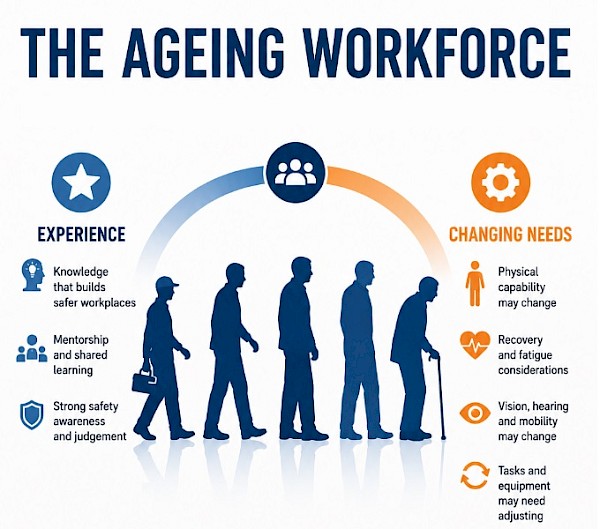
People are working for longer, and experienced workers remain an important part of the UK workforce. In construction, engineering and other physically demanding sectors, that experience can bring significant benefits including practical knowledge, better hazard awareness and a strong understanding of how work should be carried out safely.
However, recent workplace fatality statistics provide an important reason to consider whether our approach to risk management is keeping pace with an ageing workforce.
HSE's provisional figures for 2025/26 show that workers aged 60 and over accounted for around one-third of fatal injuries, despite representing a much smaller proportion of the workforce.
This does not mean that older workers are inherently less safe. Age alone should never be used as an assumption about someone's capability.
What it should prompt is a wider question:
Do our risk assessments continue to reflect the people actually carrying out the work?
Risk assessments shouldn't stand still
A risk assessment may have been suitable when originally completed, but workplaces, equipment, tasks and people change.
Physical capability can also change over time. Strength, mobility, balance, eyesight, hearing and recovery from physically demanding work may change as people get older although the extent and timing will vary significantly between individuals.
For employers, the focus should therefore remain on the demands of the task and the capability of the individual rather than simply their age.
Consider activities involving:
- regular manual handling;
- repetitive or physically demanding work;
- prolonged use of vibrating equipment;
- climbing or work at height;
- extended shifts or fatigue;
- driving and mobile plant;
- extremes of temperature; and
- physically demanding PPE or RPE.
Where these activities form part of someone's normal work, employers should consider whether existing controls continue to be effective.
Experience can be part of the solution
An ageing workforce should not simply be viewed through the lens of increased risk.
Experienced workers often possess considerable knowledge about equipment, processes and workplace hazards. Involving them in risk assessment and consultation can help businesses identify practical improvements that might otherwise be missed.
Small changes to equipment, task rotation, working methods, manual handling arrangements or working patterns may allow experienced employees to continue working safely and effectively.
The objective is not to create a separate set of rules for older employees. It is to ensure that health and safety arrangements recognise that people and their capabilities are not static.
A useful question for employers
Rather than asking:
"Is this worker too old to carry out the task?"
A better question is:
"Does the task, the working environment and the control measures remain suitable for the person carrying it out?"
A question worth asking throughout someone's working life regardless of age!
If changes in your workforce, working activities or individual capabilities raise questions about existing risk assessments, occupational health or workplace adjustments, your Principal Health & Safety Adviser can help you review whether current arrangements remain suitable.