
Almost 9 Out of Every 10 Working Days Lost Are Due to Work-Related Ill Health
When considering workplace health and safety, attention often focuses on accidents, injuries and ensuring employees return home safely. But are we giving occupational health risks the same level of attention?
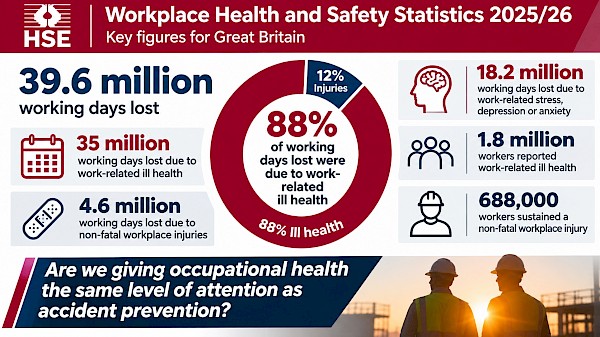
The Health and Safety Executive (HSE) published its latest annual statistics in November 2026, revealing that approximately 88% of working days lost through workplace injuries and work-related ill health were attributable to ill health.
Of the 39.6 million working days lost during 2025/26, approximately 35 million resulted from work-related ill health, compared with 4.6 million from non-fatal workplace injuries.
Even more concerning, work-related stress, depression, and anxiety alone accounted for 18.2 million working days lost, almost four times the number attributed to workplace injuries.
Are We Measuring the Right Things?
Many organisations measure their health and safety performance through accident statistics, near-miss reporting and RIDDOR notifications. Whilst these remain important indicators, they do not necessarily reflect the effectiveness of occupational health management.
A workplace reporting no accidents is not necessarily a workplace where employees' health is being adequately protected.
Unlike accidents, occupational illnesses can develop gradually, often without obvious warning signs. Exposure to excessive noise, vibration, hazardous substances, repetitive activities, and poorly managed workplace stress can have serious long-term consequences.
What Should Employers Be Considering?
The latest statistics provide an opportunity to review whether occupational health risks are being adequately managed.
Risk Assessments: Are occupational health hazards receiving the same consideration as immediate safety risks?
Health Surveillance: Are suitable arrangements in place where employees are exposed to hazards requiring ongoing health monitoring?
Work-Related Stress: Have workload, working relationships and organisational pressures been considered?
Performance Monitoring: Are sickness absence trends and occupational health concerns reviewed alongside accident statistics?
Looking Ahead to 2027
The Health and Safety at Work etc. Act 1974 requires employers to protect employees' health, safety and welfare, so far as is reasonably practicable. As organisations review their health and safety priorities for 2027, the latest HSE statistics provide a timely reminder that occupational health deserves as much attention as accident prevention.
We encourage employers to look beyond traditional accident statistics and consider whether their existing arrangements adequately protect employees from the less visible risks associated with occupational illness.
After all, keeping employees safe at work should also mean keeping them healthy.