
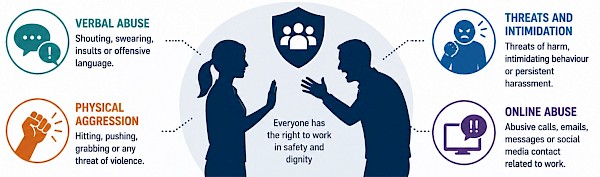
Workplace Violence and Aggression: More Than a Physical Risk
When we think about workplace violence, it is easy to picture a physical assault.
But work-related violence can begin much earlier.
Threatening behaviour, intimidation, verbal abuse and aggression towards employees can all form part of the risk that employers may need to manage.
HSE defines work-related violence as an incident in which a person is abused, threatened or assaulted in circumstances relating to their work.
That means violence and aggression should not automatically be regarded solely as an HR or disciplinary matter. Where employees could be exposed because of their work, it can also become a health and safety risk.
Who might be exposed?
The issue is particularly obvious in occupations involving security, healthcare or regular interaction with members of the public, but exposure can occur in many other roles.
Consider:
- lone workers visiting customer premises
- delivery drivers
- site managers dealing with members of the public
- employees handling complaints
- engineers attending occupied premises
- reception and front-of-house employees
- managers dealing with confrontational situations and
- employees working alone or outside normal working hours.
Previous incidents, complaints and reports from employees may also indicate where a foreseeable risk exists.
The risk isn't limited to physical injury
A threatening incident does not need to result in physical contact before it affects someone's health.
Repeated verbal abuse, intimidation or threatening behaviour can contribute to stress, anxiety and other psychological effects.
Employers should therefore consider both the likelihood of an incident occurring and its potential consequences.
Depending on the work, appropriate controls might include improved communication arrangements, lone-working procedures, training in handling difficult situations, site security, avoiding lone attendance in known higher-risk situations or establishing clear arrangements for summoning assistance.
Employees should also understand how incidents should be reported.
Reporting matters
One of the difficulties with workplace aggression is that lower-level incidents can gradually become accepted as "part of the job".
That should be challenged.
Without reporting, employers may never recognise that several employees have experienced similar incidents or that a particular location, customer, activity or working arrangement is creating a pattern.
Reporting therefore provides valuable information that can be used to review risk and decide whether additional controls are required.
Consider violence as you would any other foreseeable workplace risk
Employers do not need to eliminate every possibility of someone behaving aggressively.
They do, however, need to consider reasonably foreseeable risks arising from the work and take appropriate steps to protect employees.
The starting point is simple:
- Could the work we ask our employees to undertake reasonably expose them to abuse, threats or aggression?
If the answer is yes, it deserves consideration within the organisation's health and safety arrangements.
If violence, aggression or lone-working risks are relevant to your organisation, your Principal Adviser can support you in reviewing the risk assessments, reporting arrangements and appropriate workplace controls.